
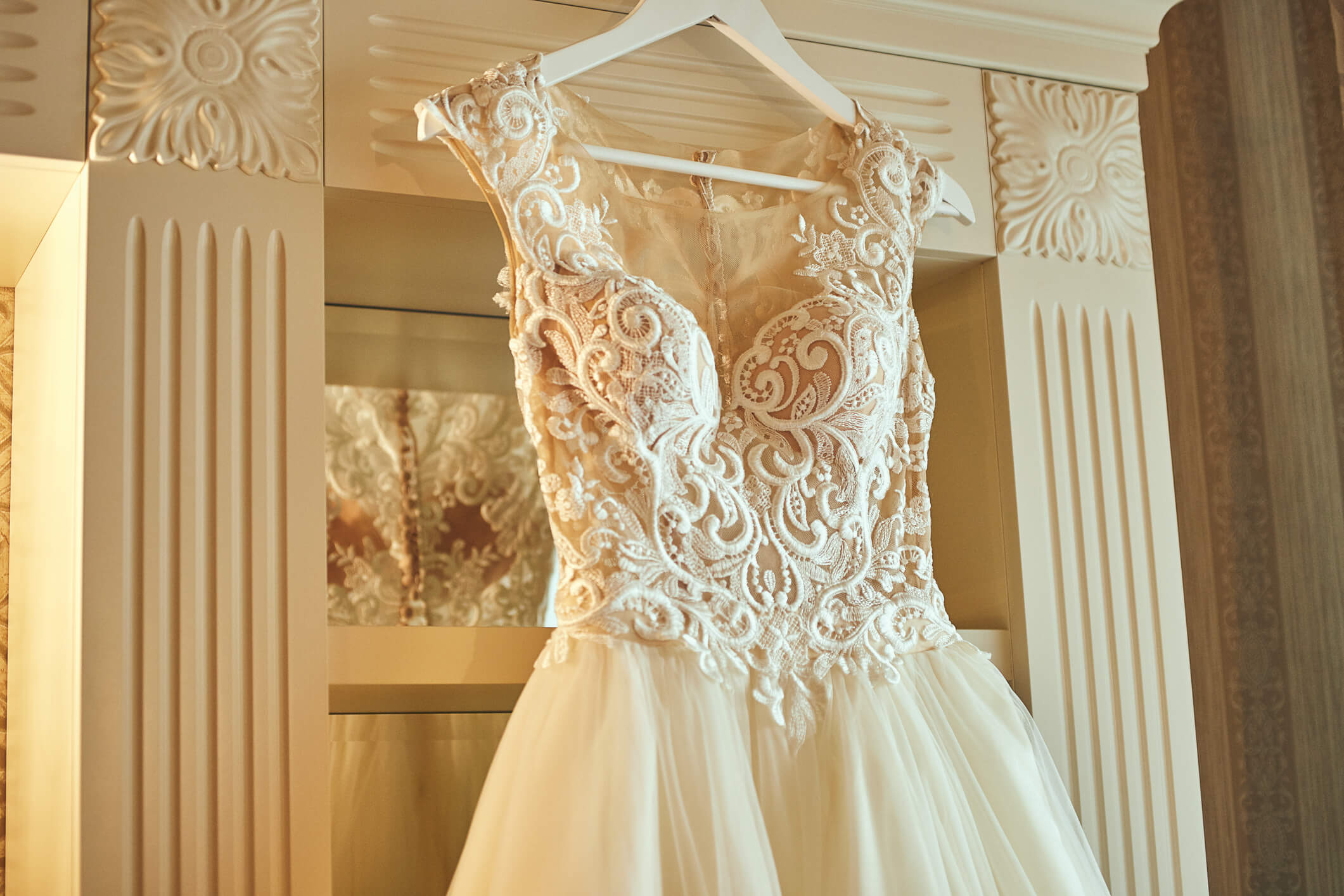
A yellowed wedding dress with no spill and no visible cause almost always points to something environmental, not something someone did wrong. Light finds its way into most closets. Temperatures swing more than people realize in an average home. Humidity works against fabric in both directions.
And the box a dress spends years inside can be the actual source of the problem. None of that is a storage failure. It’s just what happens when a delicate fabric sits somewhere for years without anyone accounting for these specific factors.
It’s Not Always Something That Happened to the Dress
A wedding dress that’s been hanging in a closet or sitting in storage, never worn again, never spilled on, can still come out yellowed years later, and that’s genuinely confusing when nothing obvious happened to it.
Wedding dress preservation isn’t just about avoiding spills or keeping a dress away from everyday wear. Yellowing and deterioration can also be influenced by storage conditions, aging, heat, moisture, light, and the materials surrounding the dress.
Guidance on proper wedding dress storage from the Dry Cleaning and Laundry Institute International (DLI) specifically recommends keeping dresses in a cool, dry location, away from basements and attics, and using appropriate acid-free tissue when the dress is boxed.
It’s also worth remembering that not every discoloration that appears during storage is purely environmental. Previously invisible food, beverage, perspiration, makeup, or body-oil stains can become visible later, which is why professional cleaning before long-term storage matters.
Light Exposure Adds Up
Direct sunlight isn’t the only light worth considering. Long-term exposure to both sunlight and indoor lighting can contribute to textile deterioration.
That’s why a dark storage location is preferable to leaving a dress exposed in a room, near a window, or somewhere it receives regular light.
Most people assume putting away a dress is enough, but the amount of protection depends on the actual storage environment:
- A dress stored near a window may still receive regular daylight.
- Garment bags and boxes don’t all provide the same degree of light protection.
- Frequently illuminated storage spaces expose textiles to more light than genuinely dark storage areas.
- Attics and basements introduce additional environmental concerns beyond light alone.
For long-term storage, the goal is straightforward: minimize unnecessary light exposure rather than trying to calculate exactly how much light is too much.
Temperature Swings Can Be Hard on Stored Textiles
Attics, garages, basements, and rooms without reliable climate control can experience substantial changes in temperature and humidity throughout the year.
Those environments aren’t ideal for a dress intended to remain in storage for years. The Smithsonian recommends a storage area that is clean, cool, dry, dark, and protected from drastic changes in temperature and humidity, specifically ruling out attics and basements for valuable textile storage.
An interior area of a climate-controlled home generally provides a more stable environment than spaces exposed to seasonal extremes.
Humidity Works Both Ways
Humidity causes problems at both ends of the scale. Excess moisture can encourage mold and mildew, while extremely dry conditions can make some natural fibers more brittle over time.
Neither extreme is ideal, which is why a stable, moderate environment matters more than simply finding somewhere that feels dry.
A basement that feels cool and out of the way can still be humid enough to create problems, while a hot, dry storage area can expose natural fibers to a different kind of stress.
A few warning signs are worth paying attention to:
- A persistent musty smell may indicate excess moisture or another storage problem.
- Fabric that feels unusually brittle or fragile deserves careful handling rather than repeated inspection.
- Visible spotting or suspected mold should be professionally assessed rather than treated aggressively at home.
The Storage Materials Themselves Can Be the Cause
This is probably the most overlooked issue on the entire list, since it can come from materials surrounding the dress rather than anything that happened on the wedding day.
Many ordinary papers and boards become acidic as they age. The Smithsonian notes that acidity from paper can transfer to adjacent textiles, potentially weakening or discoloring them over time.
A dress packed carefully in an ordinary cardboard box or wrapped in unsuitable paper, therefore, isn’t necessarily protected simply because it has been boxed.
The materials used for long-term textile storage matter:
- Acid-free materials: preservation boxes and tissue intended for textiles reduce the risk associated with ordinary acidic paper products.
- Unbuffered acid-free tissue: this is the safer general choice for wedding dresses containing unknown or mixed fibers, particularly because buffered papers may not be appropriate for silk or wool.
- White or undyed materials: these avoid unnecessary risk from dyes transferring onto the dress.
- Proper textile-storage materials: ordinary cardboard, colored tissue, and miscellaneous household wrapping paper shouldn’t be treated as substitutes for archival materials.
Super Cleaners explains the same distinction in its guide to cleaning a wedding dress before storage: preservation materials are intended to protect a properly prepared dress during storage, not remove stains or contamination already present in the fabric.
Every cause above comes back to two important questions: what condition is the dress in before storage, and what environment and materials surround it afterward?
What Helps Prevent Yellowing Going Forward
Good preservation addresses both the dress itself and its storage environment rather than relying on a box alone.
A practical checklist covers the major risks:
- Store the dress in a dark, cool, dry area of the home.
- Avoid attics, basements, garages, and spaces exposed to major temperature or humidity changes.
- Use appropriate acid-free preservation materials rather than ordinary cardboard or tissue paper.
- Use acid-free, unbuffered tissue when appropriate for the materials of the dress.
- Keep the dress away from unnecessary light exposure.
- Inspect a preserved dress periodically rather than assuming it can remain untouched indefinitely.
- If the dress is folded, periodically changing the position of folds can reduce prolonged stress on the same fibers.
Professional cleaning before storage is just as important. Invisible food, beverage, body-oil, perspiration, and makeup stains can become harder to address over time, so proper preservation begins with a clean dress rather than simply putting a worn dress into archival packaging.
Don’t Let Yellowing Go Back Into Storage Unaddressed – Bring It to Super Cleaners
If your wedding dress is already showing yellowing, putting it straight back into storage may leave the underlying issue unaddressed. Age, hidden stains, unsuitable storage conditions, and packaging materials can all contribute to discoloration, sometimes in combination.
For anyone in Las Vegas, Nevada looking for wedding dress preservation, Super Cleaners offers Wedding Dress Cleaning and Preservation Service to prepare dresses for long-term storage. Our wedding dress care services are also available to customers across our other locations and service areas.
Before you pack away the dress again, bring it to Super Cleaners for an assessment of its condition and preservation needs.
Address: 800 S. Las Vegas Blvd., Las Vegas, NV, 89101
Phone: +1 725-255-2392
Address: 9360 W. Flamingo, #108, Las Vegas, NV, 89178
Phone: +1 725-900-2532